top of page

Create perfection for hair


Create perfection for hair
Man be perfect
Hair be perfect
Split hair structure

In real life, a piece of hair that is plucked at random seems insignificant, but like the plot of a novel, it hides infinite vitality. In the animal world, hair plays a very important role. Hair can not only maintain body temperature, but also help animals camouflage to avoid enemies, as well as avoid intrusion and damage from external environments. But in today's humans, the most important function of hair is "beauty".
Hair is indeed alive, but it does not necessarily grow continuously. After a certain period of hair growth, it will temporarily stop growing and then fall off. After it is taken off, new hair will grow back. This is metabolism.
The scalp has an average of 100,000 to 350,000 hair follicles. Hair follicles can grow hair fibers, but it does not mean that every hair follicle has the ability to grow hair, because some hair follicles are used for breathing and excretion. The color and shape of the hair also varies by race and where it is born, and the average Asian has 100,000 hairs. The hair roots are hidden within the scalp and are protected by hair follicles. There are also a large number of capillaries at the bottom of the hair follicle, which can absorb the necessary nutrients from the blood. The hair follicles are surrounded by secretory glands that secrete sebum (sebum), a type of fat that makes hair shiny and waterproof.
recognize hair
The root of the hair
1. The sunken place at the root of the hair is called the dermal papilla. The dermal papilla plays an important role in maintaining hair nutrition and growth. When the dermal papilla is destroyed, the hair will stop growing and gradually wither and fall off, causing hair loss.
2. The sebaceous glands on the hair follicles are used to secrete oil, and each hair follicle has 1-6 oil glands to supply oil. The amount of oil secretion depends on whether your hair is oily, dry or normal.
3. Each follicle can grow one hair, but there is also a chance to grow 2-3 hairs.

The structure of hair
Hair is composed of epidermis, cortex, and medulla.
1. The epidermis is transparent and consists of many overlapping flat scales, the main component of which is keratin. When healthy hair is damaged, the scales of the epidermis will turn up or fall off, and the cortex will be exposed, which will cause dryness, split ends, breakage, etc... very important role.
2. The cortical layer is formed by helical protein, which has certain elasticity and toughness, and it is the main part that determines the hair color.
3. The medulla is at the core and is a group of cells located in the center of the hair. It mainly determines the softness, thickness or youthfulness of the hair.
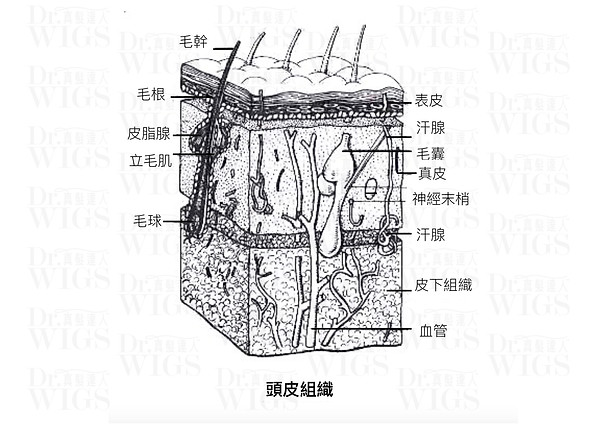
The structure of the scalp
Our scalp is full of blood vessels, nerves, sebaceous glands, sweat glands and hair follicles. The scalp must be kept clean and healthy for hair to grow properly. The average person has 140-195 sebaceous glands per square centimeter of scalp, which is denser than the skin of the face. The sebaceous glands secrete oil every day, so the skin of the head, like the skin of the face, needs frequent cleaning and careful care. Otherwise, the oil secreted by the scalp will easily become a breeding ground for bacteria, and dirt such as rain and dust will adhere to the scalp, destroying the normal metabolism of the scalp, and easily causing dandruff and related problems.
The scalp of ordinary people is weakly acidic (PH value is 4.5-5.5). If the alkaline shampoo is used, the scalp will be seriously degreasing, the acid-base balance of the scalp will be unbalanced, the epidermis will be damaged, and it will create good conditions for the growth and reproduction of certain microorganisms; Alkaline shampoo also stimulates the epithelial cells of the scalp, making it keratinized, causing increased dandruff and dry scalp.
Hair shaft:
The part that is exposed on the skin or scalp is called the hair shaft, and the hair is usually referred to as this part.
Pores:
Most hairs have their own independent outlet, but some hairs share one. This outlet is the small hole through which the hair passes through the surface of the skin or scalp, that is, the mouth of the hair follicle. It is funnel-shaped and easy to accumulate sebum here. and filth, often a breeding ground for bacteria.
Hairy roots:
It is the part of the hair inside the follicle that passes through the dermis and epidermis, and its tip is connected to the dermal papilla.
Hair follicles:
A tubular depression or pouch in the skin or scalp that tightly encloses the hair roots. Each hair has a follicle, but the depth of the follicle is not uniform due to their location on the scalp or skin and the thickness of the scalp or skin there.
Sebum Line:
It is composed of small cystic structures located in the dermis, with ducts communicating with the hair follicles, and its secretions bring luster to the hair, make the hair supple, and make the skin surface soft and bright. The amount of sebaceous gland secretions can determine whether the hair is oily, neutral or dry.
Pili muscles:
It is a bundle of involuntary muscles attached to the lower side of the hair follicle. When encountering a feeling of cold or fear, the aerator pili muscle will contract, causing the oblique hair to stand upright, making the pores bulge, showing a chicken-skin-like appearance, and compressing the sebaceous glands, making it expel secretions.
Hairball:
It is the swollen part of the hair, and the swollen space just accommodates the dermal papilla, from which the hair root and hair shaft grow. If the hair is long and thick, the hair bulb may sink deep into the subcutaneous tissue.
Hairy Nipples:
Tiny cone-shaped protrusions just sized to fit into the hair bulb. The dermal papilla is rich in blood and nerve distribution, and has blood vessels dedicated to hair nutrition. As long as you have healthy dermal papillae and get good nutrition, you can grow new hair or keep it growing. Conversely, if the dermal papilla is damaged, the hair will never grow again, so the dermal papilla is called the "mother of hair".
bottom of page